

Copper Reaction With Silver Nitrate
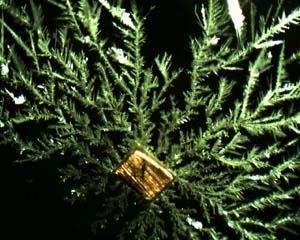
For me, this is ane of the most beautiful demonstrations. Watching fractal-similar silver crystals grow is captivating, whatever your age.
Forming silverish crystals
This demonstration can exist used as a uncomplicated introduction to reactivity or to provide an in-depth discussion of electrochemistry.
Kit
- 0.one mol dm-3 silver nitrate solution (irritant: pare and eyes);
- Pipette dropper;
- Petri dish;
- Microscope with 40× zoom;
- Copper foil (0.3 mm thickness);
- Scissors;
- tweezers;
- View camera attached to microscope;
- or microscope with integrated digital camera;
- Laptop computer and a projector (all optional).
Rubber
Silverish nitrate solution is an irritant, wear eye protection and avoid skin contact.
Procedure
Using scissors, cut a very thin slice from the copper sheet. From this slice, cutting off the smallest speck that you can come across and handle, thus ensuring you have freshly cut edges which are not corroded. Using tweezers, put the speck on a petri dish and identify the dish nether a microscope. (Notation: for smaller microscopes a glass slide tin be used instead of a petri dish.)
Focus the microscope on the copper usingca 40× magnification (I apply a 10× eye piece and 4× object lens). Carefully add one drop of silver nitrate solution to the copper and refocus the microscope. Crystals of argent volition start to abound from the edges of the copper. Enough silver is produced at this magnification to fill the view within minutes.
To show the sit-in to a form of students link a microscope to a view photographic camera, or as I practice, use a microscope with an integrated digital camera set up at twoscore× magnification, linked to a laptop estimator which is linked to a projector. By using a microscope with an integrated digital camera still images tin exist recorded, printed and included in the students' notes.
An alternative mode to demonstrate this displacement reaction is to drop a 5 cm piece of 0.5 mm copper wire into a 8 cm depth of silver nitrate solution in a boiling tube. The displacement reaction can be seen with the naked eye, merely the crystalline structure of the silvery is hard to make out.
Special tips
Almost microscopes accept the light source positioned beneath the sample platform, which produces a night outline of the crystals formed. I switch off the low-cal source and, on nighttime days, smooth an LED, clamped in position using a antiphon stand and clench, onto the sample from higher up to see the silver crystals in their true glory. If it is a sunny day, natural light tin be used past positioning the microscope near a window.
Take intendance not to reflect direct sunlight. If this is focused past a lens it tin cause blindness.
When you lot add the argent nitrate to the copper, the speck of copper tin can go suspended on the surface tension of the drop. Y'all volition demand to sink the copper before the reaction volition work finer. The three dimensional crystal structures will not stay in focus because their thickness varies and and so constant focal adjustments are required.
Teaching goals
By investigating a series of displacement reactions leaners anile xi–xiv can larn about the reactivity serial of metals. Set up a series of exam-tube reactions to investigate the displacement reactions between metals such as silvery, lead, zinc, copper and magnesium and the salts (eg sulfate, nitrate, chloride) of each of the other metals. (Note: 0.1 M atomic number 82 nitrate is toxic.) Alternatively, you can practise this in microscale using spotting tiles, which tin can be laid out in the same format as the table students use to tape their results.
When education age 14-16 students most metallic bonding in the structure and bonding topic this sit-in tin can be used to illustrate the crystalline structure of metals.
Postal service-16, students 'savour' this simple experiment as an introduction to electrochemistry. The experiment is past no means an electrochemical cell nether standard conditions employing a salt span, 1 mol dm-3 solutions, and using a high resistance voltmeter to reduce current flow, just information technology is worth showing to mail-16 students.
By seeing the crystals abound, students tin can imagine the Ag+ ions pulling electrons off the silver crystals, which in turn remove electrons from the lump of copper and produce copper ions, thus setting upwards a simple electrochemical circuit. For each copper ion that forms in solution, two silvery ions volition add together to the silvery crystal structure.
This is important to demonstrate because students might hold the misconception that the reaction takes place past silvery ions colliding with the copper, which is non the instance.

Copper Reaction With Silver Nitrate,
Source: https://edu.rsc.org/exhibition-chemistry/displacement-reaction-of-silver-nitrate-and-copper-metal/2020046.article
Posted by: newellbougereb.blogspot.com
0 Response to "Copper Reaction With Silver Nitrate"
Post a Comment