

Smallest Interval In Western Music

Melodic and harmonic intervals.
In music theory, an interval is a divergence in pitch between 2 sounds.[1] An interval may be described as horizontal, linear, or melodic if it refers to successively sounding tones, such as two adjacent pitches in a melody, and vertical or harmonic if it pertains to simultaneously sounding tones, such as in a chord.[2] [3]
In Western music, intervals are nearly commonly differences betwixt notes of a diatonic scale. Intervals between successive notes of a scale are also known every bit scale steps. The smallest of these intervals is a semitone. Intervals smaller than a semitone are called microtones. They can be formed using the notes of diverse kinds of non-diatonic scales. Some of the very smallest ones are called commas, and describe pocket-sized discrepancies, observed in some tuning systems, between enharmonically equivalent notes such every bit C ♯ and D ♭ . Intervals can be arbitrarily small, and even ephemeral to the human being ear.
In physical terms, an interval is the ratio between ii sonic frequencies. For case, any 2 notes an octave apart accept a frequency ratio of ii:1. This means that successive increments of pitch past the same interval result in an exponential increase of frequency, fifty-fifty though the human ear perceives this as a linear increment in pitch. For this reason, intervals are often measured in cents, a unit derived from the logarithm of the frequency ratio.
In Western music theory, the most common naming scheme for intervals describes 2 properties of the interval: the quality (perfect, major, minor, augmented, macerated) and number (unison, 2d, tertiary, etc.). Examples include the modest third or perfect fifth. These names identify not only the divergence in semitones between the upper and lower notes but besides how the interval is spelled. The importance of spelling stems from the historical practice of differentiating the frequency ratios of enharmonic intervals such equally G–Thousand ♯ and G–A ♭ .[iv]
Size [edit]

Example: Perfect octave on C in equal temperament and simply intonation: 2/1 = 1200 cents.
The size of an interval (too known as its width or height) can exist represented using two culling and equivalently valid methods, each appropriate to a different context: frequency ratios or cents.
Frequency ratios [edit]
The size of an interval between ii notes may exist measured past the ratio of their frequencies. When a musical instrument is tuned using a simply intonation tuning system, the size of the master intervals tin can be expressed by small-integer ratios, such as 1:1 (unison), ii:1 (octave), 5:3 (major 6th), three:2 (perfect 5th), four:three (perfect 4th), five:four (major third), 6:5 (minor 3rd). Intervals with pocket-sized-integer ratios are often called but intervals, or pure intervals.
Most ordinarily, withal, musical instruments are nowadays tuned using a dissimilar tuning system, called 12-tone equal temperament. As a outcome, the size of most equal-tempered intervals cannot be expressed by small-scale-integer ratios, although it is very close to the size of the corresponding just intervals. For instance, an equal-tempered 5th has a frequency ratio of 2 7⁄12 :1, approximately equal to 1.498:1, or 2.997:2 (very close to three:two). For a comparison between the size of intervals in unlike tuning systems, meet § Size of intervals used in different tuning systems.
Cents [edit]
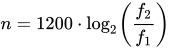
The standard arrangement for comparison interval sizes is with cents. The cent is a logarithmic unit. If frequency is expressed in a logarithmic scale, and along that calibration the distance between a given frequency and its double (also called octave) is divided into 1200 equal parts, each of these parts is one cent. In twelve-tone equal temperament (12-TET), a tuning organisation in which all semitones have the aforementioned size, the size of 1 semitone is exactly 100 cents. Hence, in 12-TET the cent tin be also defined equally one hundredth of a semitone.
Mathematically, the size in cents of the interval from frequency f 1 to frequency f ii is
Main intervals [edit]
The table shows the most widely used conventional names for the intervals between the notes of a chromatic scale. A perfect unison (also known as perfect prime)[5] is an interval formed by two identical notes. Its size is nil cents. A semitone is any interval between ii adjacent notes in a chromatic scale, a whole tone is an interval spanning two semitones (for example, a major 2d), and a tritone is an interval spanning three tones, or 6 semitones (for example, an augmented fourth).[a] Rarely, the term ditone is also used to betoken an interval spanning ii whole tones (for case, a major third), or more strictly as a synonym of major tertiary.
Intervals with different names may span the aforementioned number of semitones, and may even take the same width. For case, the interval from D to F ♯ is a major third, while that from D to Grand ♭ is a diminished fourth. However, they both span 4 semitones. If the instrument is tuned and then that the 12 notes of the chromatic scale are equally spaced (as in equal temperament), these intervals also have the same width. Namely, all semitones accept a width of 100 cents, and all intervals spanning 4 semitones are 400 cents wide.
The names listed here cannot be determined by counting semitones lonely. The rules to make up one's mind them are explained below. Other names, determined with different naming conventions, are listed in a separate section. Intervals smaller than one semitone (commas or microtones) and larger than ane octave (chemical compound intervals) are introduced below.
| Number of semitones | Pocket-size, major, or perfect intervals | Short | Augmented or diminished intervals | Short | Widely used alternative names | Short | Audio |
|---|---|---|---|---|---|---|---|
| 0 | Perfect unison[5] [b] | P1 | Diminished second | d2 |  Play(assistance·info) Play(assistance·info) | ||
| 1 | Modest second | m2 | Augmented unison[5] [b] | A1 | Semitone,[c] half tone, half step | S | Play(assistance·info) |
| two | Major second | M2 | Diminished third | d3 | Tone, whole tone, whole step | T | Play(help·info) |
| iii | Small-scale third | m3 | Augmented second | A2 | Trisemitone | Play(assistance·info) | |
| 4 | Major tertiary | M3 | Diminished fourth | d4 | Play(help·info) | ||
| 5 | Perfect 4th | P4 | Augmented third | A3 | Play(help·info) | ||
| vi | Diminished 5th | d5 | Tritone[a] | TT | Play(assist·info) | ||
| Augmented quaternary | A4 | ||||||
| vii | Perfect fifth | P5 | Diminished sixth | d6 | Play(aid·info) | ||
| 8 | Small sixth | m6 | Augmented fifth | A5 | Play(help·info) | ||
| 9 | Major sixth | M6 | Diminished seventh | d7 | Play(help·info) | ||
| 10 | Small seventh | m7 | Augmented sixth | A6 | Play(assistance·info) | ||
| 11 | Major seventh | M7 | Diminished octave | d8 | Play(aid·info) | ||
| 12 | Perfect octave | P8 | Augmented seventh | A7 | Play(aid·info) | ||
Interval number and quality [edit]

In Western music theory, an interval is named according to its number (too chosen diatonic number) and quality. For example, major third (or M3) is an interval name, in which the term major (M) describes the quality of the interval, and tertiary (3) indicates its number.
Number [edit]


The number of an interval is the number of alphabetic character names or staff positions (lines and spaces) it encompasses, including the positions of both notes forming the interval. For instance, the interval C–Chiliad is a fifth (denoted P5) because the notes from C to the G above it cover 5 letter names (C, D, E, F, M) and occupy five consecutive staff positions, including the positions of C and Yard. The tabular array and the figure above show intervals with numbers ranging from 1 (e.chiliad., P1) to eight (e.grand., P8). Intervals with larger numbers are called compound intervals.
In that location is a one-to-i correspondence between staff positions and diatonic-scale degrees (the notes of diatonic scale).[d] This means that interval numbers can also be determined by counting diatonic scale degrees, rather than staff positions, provided that the two notes that course the interval are drawn from a diatonic scale. Namely, C–Grand is a fifth because in whatsoever diatonic calibration that contains C and Thousand, the sequence from C to G includes 5 notes. For example, in the A ♭ -major diatonic scale, the five notes are C–D ♭ –Due east ♭ –F–G (run into figure). This is non true for all kinds of scales. For instance, in a chromatic calibration, the notes from C to Grand are eight (C–C ♯ –D–D ♯ –E–F–F ♯ –G). This is the reason interval numbers are as well called diatonic numbers, and this convention is called diatonic numbering.
If ane adds whatever accidentals to the notes that form an interval, by definition the notes practise not change their staff positions. As a consequence, any interval has the same interval number as the corresponding natural interval, formed by the same notes without accidentals. For instance, the intervals C–M ♯ (spanning 8 semitones) and C ♯ –G (spanning half dozen semitones) are fifths, like the corresponding natural interval C–1000 (7 semitones).
Observe that interval numbers correspond an inclusive count of encompassed staff positions or notation names, not the difference between the endpoints. In other words, one starts counting the lower pitch equally ane, non zero. For that reason, the interval C–C, a perfect unison, is chosen a prime (meaning "ane"), fifty-fifty though in that location is no difference between the endpoints. Continuing, the interval C–D is a second, but D is only one staff position, or diatonic-scale caste, above C. Similarly, C–Due east is a third, simply E is simply two staff positions above C, and so on. As a result, joining ii intervals always yields an interval number one less than their sum. For instance, the intervals C–E and E–Thousand are thirds, but joined together they form a fifth (C–G), not a 6th. Similarly, a stack of 3 thirds, such as C–E, Eastward–Thousand, and G–B, is a seventh (C–B), non a 9th.
This scheme applies to intervals upwards to an octave (12 semitones). For larger intervals, see § Compound intervals below.
Quality [edit]
The name of whatsoever interval is further qualified using the terms perfect (P), major (One thousand), minor (m), augmented (A), and diminished (d). This is called its interval quality. It is possible to accept doubly diminished and doubly augmented intervals, only these are quite rare, as they occur but in chromatic contexts. The quality of a compound interval is the quality of the unproblematic interval on which it is based.
Perfect [edit]

Perfect intervals are so-called because they were traditionally considered perfectly consonant,[six] although in Western classical music the perfect 4th was sometimes regarded as a less than perfect consonance, when its function was contrapuntal.[ vague ] Conversely, pocket-size, major, augmented or macerated intervals are typically considered less consonant, and were traditionally classified as mediocre consonances, imperfect consonances, or dissonances.[6]
Within a diatonic calibration[d] all unisons (P1) and octaves (P8) are perfect. Virtually fourths and fifths are too perfect (P4 and P5), with 5 and 7 semitones respectively. One occurrence of a quaternary is augmented (A4) and 1 fifth is diminished (d5), both spanning six semitones. For instance, in a C-major scale, the A4 is between F and B, and the d5 is between B and F (run into table).
By definition, the inversion of a perfect interval is also perfect. Since the inversion does not change the pitch class of the 2 notes, it hardly affects their level of consonance (matching of their harmonics). Conversely, other kinds of intervals have the opposite quality with respect to their inversion. The inversion of a major interval is a minor interval, the inversion of an augmented interval is a diminished interval.
Major and small [edit]

As shown in the table, a diatonic scale[d] defines seven intervals for each interval number, each starting from a different annotation (seven unisons, seven seconds, etc.). The intervals formed by the notes of a diatonic calibration are called diatonic. Except for unisons and octaves, the diatonic intervals with a given interval number always occur in two sizes, which differ by ane semitone. For example, 6 of the fifths span seven semitones. The other i spans 6 semitones. Four of the thirds span three semitones, the others four. If i of the two versions is a perfect interval, the other is called either diminished (i.e. narrowed past one semitone) or augmented (i.e. widened by 1 semitone). Otherwise, the larger version is chosen major, the smaller ane pocket-sized. For instance, since a seven-semitone fifth is a perfect interval (P5), the 6-semitone fifth is called "macerated fifth" (d5). Conversely, since neither kind of third is perfect, the larger one is called "major third" (M3), the smaller one "minor third" (m3).
Inside a diatonic scale,[d] unisons and octaves are always qualified as perfect, fourths as either perfect or augmented, fifths as perfect or diminished, and all the other intervals (seconds, thirds, sixths, sevenths) every bit major or minor.
Augmented and macerated [edit]

Augmented and diminished intervals on C. d2(assistance·info) , A2(assistance·info) , d3(help·info) , A3(help·info) , d4(help·info) , A4(help·info) , d5(assistance·info) , A5(assistance·info) , d6(assist·info) , A6(help·info) , d7(assistance·info) , A7(help·info) , d8(help·info) , A8(assistance·info)
Augmented intervals are wider by one semitone than perfect or major intervals, while having the aforementioned interval number (i.eastward., encompassing the same number of staff positions). Diminished intervals, on the other hand, are narrower past one semitone than perfect or modest intervals of the same interval number. For example, an augmented third such every bit C–East ♯ spans five semitones, exceeding a major tertiary (C–Eastward) by one semitone, while a macerated third such as C ♯ –East ♭ spans 2 semitones, falling short of a modest third (C–E ♭ ) by ane semitone.
The augmented fourth (A4) and the diminished fifth (d5) are the merely augmented and diminished intervals that appear in diatonic scales[d] (see table).
Instance [edit]
Neither the number, nor the quality of an interval can exist determined by counting semitones lonely. As explained in a higher place, the number of staff positions must be taken into account besides.
For case, as shown in the tabular array below, there are four semitones betwixt A ♭ and B ♯ , betwixt A and C ♯ , between A and D ♭ , and between A ♯ and E  , but
, but
- A ♭ –B ♯ is a second, as information technology encompasses two staff positions (A, B), and information technology is doubly augmented, as it exceeds a major second (such as A–B) by two semitones.
- A–C ♯ is a third, as information technology encompasses three staff positions (A, B, C), and information technology is major, every bit it spans four semitones.
- A–D ♭ is a quaternary, as information technology encompasses four staff positions (A, B, C, D), and it is diminished, equally information technology falls short of a perfect fourth (such as A–D) by one semitone.
- A ♯ -E is a fifth, every bit information technology encompasses 5 staff positions (A, B, C, D, E), and it is triply macerated, as information technology falls short of a perfect fifth (such every bit A–East) by three semitones.
| Number of semitones | Interval name | Staff positions | ||||
|---|---|---|---|---|---|---|
| i | 2 | 3 | iv | v | ||
| 4 | doubly augmented 2d (AA2) | A ♭ | B ♯ | |||
| 4 | major third (M3) | A | C ♯ | |||
| 4 | diminished quaternary (d4) | A | D ♭ | |||
| four | triply diminished fifth (ddd5) | A ♯ | Due east | |||
Shorthand notation [edit]
Intervals are oftentimes abbreviated with a P for perfect, m for modest, M for major, d for diminished, A for augmented, followed by the interval number. The indications Chiliad and P are often omitted. The octave is P8, and a unison is usually referred to simply as "a unison" simply can exist labeled P1. The tritone, an augmented fourth or diminished fifth is oftentimes TT. The interval qualities may be also abbreviated with perf, min, maj, dim, aug. Examples:
- m2 (or min2): minor second,
- M3 (or maj3): major third,
- A4 (or aug4): augmented fourth,
- d5 (or dim5): diminished fifth,
- P5 (or perf5): perfect fifth.
Inversion [edit]

Major 13th (chemical compound Major sixth) inverts to a small 3rd by moving the lesser note upwards two octaves, the top note downwards ii octaves, or both notes one octave
A simple interval (i.eastward., an interval smaller than or equal to an octave) may be inverted by raising the lower pitch an octave or lowering the upper pitch an octave. For example, the 4th from a lower C to a higher F may be inverted to make a fifth, from a lower F to a higher C.

There are 2 rules to determine the number and quality of the inversion of any simple interval:[7]
- The interval number and the number of its inversion ever add up to nine (4 + 5 = nine, in the example but given).
- The inversion of a major interval is a modest interval, and vice versa; the inversion of a perfect interval is also perfect; the inversion of an augmented interval is a diminished interval, and vice versa; the inversion of a doubly augmented interval is a doubly diminished interval, and vice versa.
For case, the interval from C to the E ♭ above it is a minor tertiary. By the two rules just given, the interval from E ♭ to the C above information technology must be a major 6th.
Since compound intervals are larger than an octave, "the inversion of whatever compound interval is e'er the same as the inversion of the simple interval from which information technology is compounded."[viii]
For intervals identified by their ratio, the inversion is adamant past reversing the ratio and multiplying the ratio by 2 until it is greater than 1. For example, the inversion of a five:four ratio is an 8:v ratio.
For intervals identified by an integer number of semitones, the inversion is obtained by subtracting that number from 12.
Since an interval class is the lower number selected among the interval integer and its inversion, interval classes cannot exist inverted.
Nomenclature [edit]
Intervals tin can be described, classified, or compared with each other co-ordinate to diverse criteria.

Melodic and harmonic intervals.
Melodic and harmonic [edit]
An interval tin can exist described every bit
- Vertical or harmonic if the ii notes sound simultaneously
- Horizontal, linear, or melodic if they sound successively.[2] Melodic intervals can be ascending (lower pitch precedes college pitch) or descending.
Diatonic and chromatic [edit]
In general,
- A diatonic interval is an interval formed by two notes of a diatonic scale.
- A chromatic interval is a non-diatonic interval formed by two notes of a chromatic calibration.

Ascending and descending chromatic calibration on C
The table above depicts the 56 diatonic intervals formed by the notes of the C major scale (a diatonic calibration). Notice that these intervals, every bit well as any other diatonic interval, can be too formed past the notes of a chromatic calibration.
The stardom between diatonic and chromatic intervals is controversial, as it is based on the definition of diatonic scale, which is variable in the literature. For case, the interval B–East ♭ (a diminished fourth, occurring in the harmonic C-minor scale) is considered diatonic if the harmonic minor scales are considered diatonic as well.[9] Otherwise, it is considered chromatic. For further details, see the main commodity.
By a commonly used definition of diatonic calibration[d] (which excludes the harmonic minor and melodic minor scales), all perfect, major and minor intervals are diatonic. Conversely, no augmented or diminished interval is diatonic, except for the augmented fourth and diminished fifth.

The distinction betwixt diatonic and chromatic intervals may be likewise sensitive to context. The above-mentioned 56 intervals formed past the C-major calibration are sometimes chosen diatonic to C major. All other intervals are called chromatic to C major. For instance, the perfect fifth A ♭ –E ♭ is chromatic to C major, because A ♭ and E ♭ are not independent in the C major scale. Even so, it is diatonic to others, such as the A ♭ major scale.
Consonant and anomalous [edit]
Consonance and dissonance are relative terms that refer to the stability, or country of repose, of particular musical effects. Dissonant intervals are those that cause tension and desire to be resolved to consonant intervals.
These terms are relative to the usage of different compositional styles.
- In 15th- and 16th-century usage, perfect fifths and octaves, and major and minor thirds and sixths were considered harmonically consonant, and all other intervals dissonant, including the perfect fourth, which by 1473 was described (by Johannes Tinctoris) as dissonant, except between the upper parts of a vertical sonority—for example, with a supporting third below ("6-three chords").[10] In the common practice period, it makes more sense to speak of consonant and anomalous chords, and sure intervals previously considered dissonant (such as minor sevenths) became acceptable in certain contexts. All the same, 16th-century practise was still taught to beginning musicians throughout this period.
- Hermann von Helmholtz (1821–1894) theorised that dissonance was acquired by the presence of beats.[xi] von Helmholtz further believed that the beating produced by the upper partials of harmonic sounds was the cause of dissonance for intervals besides far apart to produce beating between the fundamentals.[12] von Helmholtz and then designated that two harmonic tones that shared mutual low partials would be more consonant, as they produced less beats.[13] [fourteen] von Helmholtz disregarded partials above the seventh, as he believed that they were non aural enough to have pregnant effect.[xv] From this von Helmholtz categorises the octave, perfect fifth, perfect 4th, major sixth, major tertiary, and small-scale 3rd as consonant, in decreasing value, and other intervals as dissonant.
- David Cope (1997) suggests the concept of interval force,[16] in which an interval'due south forcefulness, consonance, or stability is adamant by its approximation to a lower and stronger, or college and weaker, position in the harmonic series. See also: Lipps–Meyer law and #Interval root
All of the above analyses refer to vertical (simultaneous) intervals.
Simple and compound [edit]

Elementary and compound major third
A uncomplicated interval is an interval spanning at most one octave (see Main intervals in a higher place). Intervals spanning more than i octave are chosen compound intervals, as they can exist obtained by adding one or more octaves to a uncomplicated interval (encounter below for details).[17]
Steps and skips [edit]
Linear (melodic) intervals may be described every bit steps or skips. A step, or conjunct move,[18] is a linear interval betwixt two consecutive notes of a scale. Whatever larger interval is chosen a skip (also called a leap), or disjunct motion.[eighteen] In the diatonic calibration,[d] a step is either a modest second (sometimes also called half pace) or major second (sometimes likewise chosen whole step), with all intervals of a pocket-size third or larger being skips.
For example, C to D (major second) is a stride, whereas C to E (major 3rd) is a skip.
More generally, a step is a smaller or narrower interval in a musical line, and a skip is a wider or larger interval, where the categorization of intervals into steps and skips is determined by the tuning system and the pitch space used.
Melodic motion in which the interval between any two sequent pitches is no more than a step, or, less strictly, where skips are rare, is chosen stepwise or conjunct melodic move, as opposed to skipwise or disjunct melodic motions, characterized by frequent skips.
Enharmonic intervals [edit]
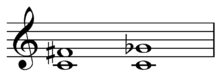
Enharmonic tritones: A4 = d5 on C
Ii intervals are considered enharmonic, or enharmonically equivalent, if they both contain the same pitches spelled in different means; that is, if the notes in the two intervals are themselves enharmonically equivalent. Enharmonic intervals span the same number of semitones.
For example, the four intervals listed in the table beneath are all enharmonically equivalent, considering the notes F ♯ and G ♭ indicate the aforementioned pitch, and the aforementioned is true for A ♯ and B ♭ . All these intervals span iv semitones.
| Number of semitones | Interval name | Staff positions | |||
|---|---|---|---|---|---|
| one | 2 | 3 | 4 | ||
| 4 | major third | F ♯ | A ♯ | ||
| 4 | major third | Chiliad ♭ | B ♭ | ||
| 4 | diminished fourth | F ♯ | B ♭ | ||
| four | doubly augmented 2nd | M ♭ | A ♯ | ||
When played as isolated chords on a piano keyboard, these intervals are indistinguishable to the ear, because they are all played with the same two keys. Even so, in a musical context, the diatonic role of the notes these intervals incorporate is very different.
The discussion higher up assumes the use of the prevalent tuning system, 12-tone equal temperament ("12-TET"). Merely in other historic meantone temperaments, the pitches of pairs of notes such as F ♯ and G ♭ may not necessarily coincide. These two notes are enharmonic in 12-TET, but may not be and then in another tuning organisation. In such cases, the intervals they class would also non be enharmonic. For example, in quarter-comma meantone, all four intervals shown in the example above would exist unlike.
Minute intervals [edit]
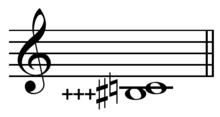
Pythagorean comma on C; the notation depicted as lower on the staff (B ♯ +++) is slightly higher in pitch (than C ♮ ).
At that place are also a number of minute intervals not institute in the chromatic scale or labeled with a diatonic function, which take names of their own. They may be described as microtones, and some of them tin can be likewise classified as commas, as they describe small discrepancies, observed in some tuning systems, between enharmonically equivalent notes. In the post-obit list, the interval sizes in cents are approximate.
- A Pythagorean comma is the difference between twelve justly tuned perfect fifths and 7 octaves. It is expressed past the frequency ratio 531441:524288 (23.5 cents).
- A syntonic comma is the deviation between iv justly tuned perfect fifths and two octaves plus a major third. It is expressed past the ratio 81:80 (21.five cents).
- A septimal comma is 64:63 (27.3 cents), and is the departure betwixt the Pythagorean or 3-limit "seventh" and the "harmonic 7th".
- A diesis is generally used to mean the difference between three justly tuned major thirds and one octave. It is expressed by the ratio 128:125 (41.1 cents). Withal, it has been used to mean other modest intervals: see diesis for details.
- A diaschisma is the difference between iii octaves and four justly tuned perfect fifths plus two justly tuned major thirds. It is expressed by the ratio 2048:2025 (19.6 cents).
- A schisma (also skhisma) is the divergence between 5 octaves and eight justly tuned fifths plus 1 justly tuned major third. Information technology is expressed by the ratio 32805:32768 (ii.0 cents). It is also the divergence between the Pythagorean and syntonic commas. (A schismic major tertiary is a schisma dissimilar from a just major third, viii fifths down and five octaves up, F ♭ in C.)
- A kleisma is the difference betwixt vi small thirds and one tritave or perfect twelfth (an octave plus a perfect fifth), with a frequency ratio of 15625:15552 (viii.1 cents) ( Play(help·info) ).
- A septimal kleisma is the corporeality that 2 major thirds of 5:4 and a septimal major tertiary, or supermajor tertiary, of 9:vii exceeds the octave. Ratio 225:224 (7.7 cents).
- A quarter tone is half the width of a semitone, which is half the width of a whole tone. It is equal to exactly l cents.
Chemical compound intervals [edit]
Simple and compound major 3rd
A compound interval is an interval spanning more than one octave.[17] Conversely, intervals spanning at most one octave are called simple intervals (see Main intervals beneath).
In general, a chemical compound interval may be defined by a sequence or "stack" of ii or more simple intervals of any kind. For example, a major 10th (two staff positions in a higher place i octave), also called chemical compound major third, spans one octave plus i major tertiary.
Whatsoever compound interval can be always decomposed into one or more octaves plus one simple interval. For instance, a major seventeenth tin be decomposed into two octaves and i major tertiary, and this is the reason why it is chosen a compound major third, even when it is congenital by calculation up four fifths.
The diatonic number DN c of a compound interval formed from due north unproblematic intervals with diatonic numbers DN ane, DN 2, ..., DN n, is adamant by:

which can also be written as:

The quality of a compound interval is determined past the quality of the uncomplicated interval on which information technology is based. For instance, a chemical compound major third is a major tenth (i+(8−1)+(3−1) = ten), or a major seventeenth (1+(8−1)+(8−1)+(3−1) = 17), and a compound perfect fifth is a perfect twelfth (1+(8−1)+(5−1) = 12) or a perfect nineteenth (ane+(8−1)+(8−1)+(5−one) = 19). Discover that two octaves are a fifteenth, non a sixteenth (ane+(8−ane)+(viii−1) = fifteen). Similarly, three octaves are a twenty-second (1+3×(8−i) = 22), and so on.
Main chemical compound intervals [edit]
| Number of semitones | Pocket-size, major, or perfect intervals | Brusk | Augmented or diminished intervals | Curt |
|---|---|---|---|---|
| 12 | Diminished ninth | d9 | ||
| 13 | Pocket-sized ninth | m9 | Augmented octave | A8 |
| 14 | Major ninth | M9 | Macerated tenth | d10 |
| 15 | Minor tenth | m10 | Augmented ninth | A9 |
| sixteen | Major tenth | M10 | Macerated eleventh | d11 |
| 17 | Perfect eleventh | P11 | Augmented 10th | A10 |
| eighteen | Diminished twelfth | d12 | ||
| Augmented eleventh | A11 | |||
| 19 | Perfect 12th or Tritave | P12 | Macerated thirteenth | d13 |
| xx | Pocket-size thirteenth | m13 | Augmented twelfth | A12 |
| 21 | Major thirteenth | M13 | Diminished fourteenth | d14 |
| 22 | Minor fourteenth | m14 | Augmented thirteenth | A13 |
| 23 | Major fourteenth | M14 | Diminished fifteenth | d15 |
| 24 | Perfect fifteenth or Double octave | P15 | Augmented fourteenth | A14 |
| 25 | Augmented fifteenth | A15 |
It is likewise worth mentioning here the major seventeenth (28 semitones)—an interval larger than two octaves that can be considered a multiple of a perfect 5th (7 semitones) as it tin can exist decomposed into iv perfect fifths (7 × four = 28 semitones), or 2 octaves plus a major third (12 + 12 + 4 = 28 semitones). Intervals larger than a major seventeenth seldom come up, almost often being referred to by their compound names, for example "two octaves plus a fifth"[19] rather than "a 19th".
Intervals in chords [edit]
Chords are sets of iii or more notes. They are typically defined equally the combination of intervals starting from a common notation called the root of the chord. For instance a major triad is a chord containing three notes defined by the root and two intervals (major tertiary and perfect fifth). Sometimes even a single interval (dyad) is considered a chord.[xx] Chords are classified based on the quality and number of the intervals that define them.
Chord qualities and interval qualities [edit]
The main chord qualities are major, small-scale, augmented, diminished, half-diminished, and dominant. The symbols used for chord quality are similar to those used for interval quality (run across to a higher place). In addition, + or aug is used for augmented, ° or dim for diminished, ø for one-half diminished, and dom for dominant (the symbol − alone is non used for macerated).
Deducing component intervals from chord names and symbols [edit]
The main rules to decode chord names or symbols are summarized below. Further details are given at Rules to decode chord names and symbols.
- For iii-note chords (triads), major or minor always refer to the interval of the tertiary in a higher place the root note, while augmented and diminished e'er refer to the interval of the fifth higher up root. The same is truthful for the corresponding symbols (e.thousand., Cm means Cm3, and C+ means C+5). Thus, the terms third and 5th and the corresponding symbols 3 and v are typically omitted. This rule can exist generalized to all kinds of chords,[e] provided the above-mentioned qualities appear immediately after the root notation, or at the beginning of the chord proper noun or symbol. For instance, in the chord symbols Cm and Cm7, m refers to the interval m3, and 3 is omitted. When these qualities do non appear immediately after the root note, or at the first of the name or symbol, they should be considered interval qualities, rather than chord qualities. For case, in CmM7 (minor major seventh chord), thousand is the chord quality and refers to the m3 interval, while M refers to the M7 interval. When the number of an actress interval is specified immediately later on chord quality, the quality of that interval may coincide with chord quality (eastward.g., CM7 = CMM7). However, this is non always true (eastward.g., Cm6 = CmM6, C+7 = C+m7, CM11 = CMP11).[eastward] See main article for further details.
- Without opposite information, a major third interval and a perfect fifth interval (major triad) are implied. For instance, a C chord is a C major triad, and the name C small 7th (Cm7) implies a pocket-size tertiary by rule 1, a perfect fifth past this rule, and a minor 7th by definition (see below). This dominion has one exception (come across next dominion).
- When the fifth interval is macerated, the third must be modest.[f] This rule overrides rule ii. For instance, Cdim7 implies a diminished 5th by rule 1, a minor 3rd by this dominion, and a diminished 7th by definition (meet below).
- Names and symbols that contain merely a plain interval number (e.g., "seventh chord") or the chord root and a number (eastward.1000., "C 7th", or C7) are interpreted as follows:
- If the number is 2, 4, vi, etc., the chord is a major added tone chord (e.g., Csix = CM6 = Cadd6) and contains, together with the implied major triad, an extra major 2d, perfect 4th, or major sixth (run into names and symbols for added tone chords).
- If the number is seven, 9, eleven, 13, etc., the chord is dominant (e.g., C7 = Cdom7) and contains, together with the unsaid major triad, one or more of the following actress intervals: minor 7th, major 9th, perfect 11th, and major 13th (come across names and symbols for 7th and extended chords).
- If the number is 5, the chord (technically not a chord in the traditional sense, just a dyad) is a power chord. Only the root, a perfect fifth and usually an octave are played.
The tabular array shows the intervals independent in some of the chief chords (component intervals), and some of the symbols used to announce them. The interval qualities or numbers in boldface font tin be deduced from chord name or symbol by applying rule 1. In symbol examples, C is used as chord root.
| Chief chords | Component intervals | |||
|---|---|---|---|---|
| Name | Symbol examples | Third | Fifth | Seventh |
| Major triad | C | M3 | P5 | |
| CM, or Cmaj | One thousandthree | P5 | ||
| Minor triad | Cm, or Cmin | 10003 | P5 | |
| Augmented triad | C+, or Caug | M3 | A5 | |
| Diminished triad | C°, or Cdim | m3 | d5 | |
| Ascendant 7th chord | C7, or Cdom7 | M3 | P5 | m7 |
| Minor seventh chord | Cm7, or Cminvii | miii | P5 | thousandseven |
| Major seventh chord | CM7, or Cmaj7 | Yardthree | P5 | M7 |
| Augmented 7th chord | C+seven, Caugseven, C7 ♯ 5, or C7aug5 | M3 | A5 | m7 |
| Diminished seventh chord | C°seven, or Cdim7 | m3 | d5 | d7 |
| One-half-diminished seventh chord | C ø 7, Cmvii ♭ 5, or Cm7dim5 | m3 | d5 | m7 |
Size of intervals used in different tuning systems [edit]
| Number of semitones | Name | 5-limit tuning (pitch ratio) | Comparison of interval width (in cents) | |||
|---|---|---|---|---|---|---|
| 5-limit tuning | Pythagorean tuning | 1⁄4 -comma meantone | Equal temperament | |||
| 0 | Perfect unison | i:1 | 0 | 0 | 0 | 0 |
| 1 | Minor second | 16:15 27:25 | 112 133 | xc | 117 | 100 |
| 2 | Major second | 9:8 10:9 | 204 182 | 204 | 193 | 200 |
| three | Minor tertiary | 6:5 32:27 | 316 294 | 294 318 | 310 (wolf) 269 | 300 |
| 4 | Major 3rd | 5:4 | 386 | 408 384 | 386 (wolf) 427 | 400 |
| v | Perfect 4th | 4:3 27:20 | 498 520 | 498 (wolf) 522 | 503 (wolf) 462 | 500 |
| 6 | Augmented fourth Diminished 5th | 45:32 25:18 | 590 569 | 612 588 | 579 621 | 600 |
| 7 | Perfect 5th | 3:2 40:27 | 702 680 | 702 (wolf) 678 | 697 (wolf) 738 | 700 |
| 8 | Pocket-size sixth | eight:5 | 814 | 792 | 814 | 800 |
| 9 | Major sixth | 5:3 27:sixteen | 884 906 | 906 | 890 | 900 |
| 10 | Modest seventh | sixteen:nine 9:5 | 996 1018 | 996 | 1007 | 1000 |
| xi | Major seventh | fifteen:8 50:27 | 1088 1067 | 1110 | 1083 | 1100 |
| 12 | Perfect octave | 2:1 | 1200 | 1200 | 1200 | 1200 |
In this table, the interval widths used in four different tuning systems are compared. To facilitate comparison, just intervals as provided past 5-limit tuning (see symmetric calibration n.i) are shown in assuming font, and the values in cents are rounded to integers. Notice that in each of the not-equal tuning systems, by definition the width of each type of interval (including the semitone) changes depending on the note that starts the interval. This is the fine art of just intonation. In equal temperament, the intervals are never precisely in tune with each other. This is the price of using equidistant intervals in a 12-tone scale. For simplicity, for some types of interval the table shows only one value (the about often observed 1).
In ane⁄iv -comma meantone, by definition 11 perfect fifths have a size of approximately 697 cents (700 −ε cents, where ε ≈ 3.42 cents); since the average size of the 12 fifths must equal exactly 700 cents (equally in equal temperament), the other one must have a size of near 738 cents (700 + 11ε, the wolf fifth or macerated sixth); 8 major thirds take size almost 386 cents (400 − 4ε), four take size near 427 cents (400 + 8ε, actually diminished fourths), and their average size is 400 cents. In brusque, like differences in width are observed for all interval types, except for unisons and octaves, and they are all multiples of ε (the difference betwixt the 1⁄4 -comma meantone fifth and the boilerplate fifth). A more detailed analysis is provided at 1⁄4 -comma meantone Size of intervals. Notation that i⁄four -comma meantone was designed to produce but major thirds, but just eight of them are just (five:iv, about 386 cents).
The Pythagorean tuning is characterized by smaller differences considering they are multiples of a smaller ε (ε ≈ 1.96 cents, the difference between the Pythagorean fifth and the boilerplate fifth). Detect that here the fifth is wider than 700 cents, while in nigh meantone temperaments, including 1⁄4 -comma meantone, it is tempered to a size smaller than 700. A more detailed analysis is provided at Pythagorean tuning § Size of intervals.
The five-limit tuning system uses just tones and semitones as building blocks, rather than a stack of perfect fifths, and this leads to even more varied intervals throughout the scale (each kind of interval has three or four different sizes). A more detailed analysis is provided at 5-limit tuning § Size of intervals. Note that five-limit tuning was designed to maximize the number of just intervals, but fifty-fifty in this system some intervals are not just (e.chiliad., 3 fifths, 5 major thirds and 6 minor thirds are not just; too, three major and 3 minor thirds are wolf intervals).
The higher up-mentioned symmetric scale 1, defined in the 5-limit tuning system, is not the just method to obtain just intonation. It is possible to construct juster intervals or just intervals closer to the equal-tempered equivalents, just most of the ones listed higher up have been used historically in equivalent contexts. In item, the asymmetric version of the 5-limit tuning scale provides a juster value for the minor 7th (nine:5, rather than 16:nine). Moreover, the tritone (augmented fourth or diminished fifth), could have other just ratios; for instance, vii:five (about 583 cents) or 17:12 (almost 603 cents) are possible alternatives for the augmented fourth (the latter is fairly common, equally information technology is closer to the equal-tempered value of 600 cents). The 7:4 interval (about 969 cents), also known as the harmonic 7th, has been a contentious consequence throughout the history of music theory; it is 31 cents flatter than an equal-tempered modest 7th. For further details about reference ratios, see five-limit tuning § The justest ratios.
In the diatonic organization, every interval has one or more than enharmonic equivalents, such as augmented second for pocket-size tertiary.
Interval root [edit]

Although intervals are usually designated in relation to their lower notation, David Cope[xvi] and Hindemith[21] both suggest the concept of interval root. To make up one's mind an interval's root, one locates its nearest approximation in the harmonic series. The root of a perfect fourth, then, is its top notation because it is an octave of the fundamental in the hypothetical harmonic series. The bottom note of every odd diatonically numbered intervals are the roots, as are the tops of all fifty-fifty numbered intervals. The root of a drove of intervals or a chord is thus determined past the interval root of its strongest interval.
As to its usefulness, Cope[16] provides the case of the final tonic chord of some popular music beingness traditionally analyzable equally a "submediant six-v chord" (added sixth chords by pop terminology), or a first inversion seventh chord (possibly the dominant of the mediant Five/iii). According to the interval root of the strongest interval of the chord (in outset inversion, CEGA), the perfect fifth (C–Grand), is the bottom C, the tonic.
Interval cycles [edit]
Interval cycles, "unfold [i.e., repeat] a single recurrent interval in a series that closes with a return to the initial pitch class", and are notated by George Perle using the letter "C", for wheel, with an interval-class integer to distinguish the interval. Thus the diminished-seventh chord would exist C3 and the augmented triad would exist C4. A superscript may be added to distinguish between transpositions, using 0–eleven to indicate the lowest pitch course in the wheel.[22]
Alternative interval naming conventions [edit]
Every bit shown below, some of the above-mentioned intervals accept alternative names, and some of them take a specific alternative proper noun in Pythagorean tuning, five-limit tuning, or meantone temperament tuning systems such as quarter-comma meantone. All the intervals with prefix sesqui- are justly tuned, and their frequency ratio, shown in the tabular array, is a superparticular number (or epimoric ratio). The same is true for the octave.
Typically, a comma is a diminished second, but this is not always true (for more details, see Alternative definitions of comma). For instance, in Pythagorean tuning the diminished second is a descending interval (524288:531441, or about −23.5 cents), and the Pythagorean comma is its opposite (531441:524288, or about 23.5 cents). 5-limit tuning defines four kinds of comma, three of which see the definition of diminished 2d, and hence are listed in the table below. The fourth 1, called syntonic comma (81:80) can neither be regarded as a diminished 2nd, nor equally its opposite. See Macerated seconds in 5-limit tuning for further details.
| Number of semitones | Generic names | Specific names | |||||
|---|---|---|---|---|---|---|---|
| Quality and number | Other naming convention | Pythagorean tuning | 5-limit tuning | 1⁄iv -comma meantone | |||
| Full | Brusque | ||||||
| 0 | perfect unison or perfect prime number | P1 | |||||
| diminished second | d2 | descending Pythagorean comma (524288:531441) | lesser diesis (128:125) | ||||
| diaschisma (2048:2025) greater diesis (648:625) | |||||||
| 1 | minor 2nd | m2 | semitone, one-half tone, half stride | diatonic semitone, major semitone | limma (256:243) | ||
| augmented unison or augmented prime number | A1 | chromatic semitone, minor semitone | apotome (2187:2048) | ||||
| 2 | major 2nd | M2 | tone, whole tone, whole step | sesquioctavum (9:8) | |||
| 3 | minor third | m3 | sesquiquintum (6:5) | ||||
| iv | major third | M3 | sesquiquartum (5:4) | ||||
| v | perfect 4th | P4 | sesquitertium (4:3) | ||||
| 6 | macerated fifth | d5 | tritone[a] | ||||
| augmented quaternary | A4 | ||||||
| 7 | perfect fifth | P5 | sesquialterum (3:ii) | ||||
| 12 | perfect octave | P8 | duplex (2:i) | ||||
Additionally, some cultures around the world have their ain names for intervals plant in their music. For instance, 22 kinds of intervals, called shrutis, are canonically defined in Indian classical music.
Latin nomenclature [edit]
Up to the finish of the 18th century, Latin was used as an official language throughout Europe for scientific and music textbooks. In music, many English language terms are derived from Latin. For instance, semitone is from Latin semitonus .
The prefix semi- is typically used herein to mean "shorter", rather than "half".[23] [24] [25] Namely, a semitonus, semiditonus, semidiatessaron, semidiapente, semihexachordum, semiheptachordum, or semidiapason, is shorter past 1 semitone than the corresponding whole interval. For example, a semiditonus (three semitones, or about 300 cents) is non half of a ditonus (4 semitones, or almost 400 cents), merely a ditonus shortened past one semitone. Moreover, in Pythagorean tuning (the most commonly used tuning arrangement upwards to the 16th century), a semitritonus (d5) is smaller than a tritonus (A4) by one Pythagorean comma (most a quarter of a semitone).
| Number of semitones | Quality and number | Short | Latin classification |
|---|---|---|---|
| 0 | Perfect unison | P1 | unisonus |
| 1 | Minor second | m2 | semitonus |
| Augmented unison | A1 | unisonus superflua | |
| 2 | Major 2nd | M2 | tonus |
| Diminished third | d3 | ||
| 3 | Modest third | m3 | semiditonus |
| Augmented second | A2 | tonus superflua | |
| 4 | Major 3rd | M3 | ditonus |
| Diminished fourth | d4 | semidiatessaron | |
| 5 | Perfect fourth | P4 | diatessaron |
| Augmented third | A3 | ditonus superflua | |
| 6 | Diminished 5th | d5 | semidiapente, semitritonus |
| Augmented fourth | A4 | tritonus | |
| seven | Perfect fifth | P5 | diapente |
| Macerated sixth | d6 | semihexachordum | |
| viii | Minor sixth | m6 | hexachordum minus, semitonus maius cum diapente, tetratonus |
| Augmented fifth | A5 | diapente superflua | |
| 9 | Major sixth | M6 | hexachordum maius, tonus cum diapente |
| Diminished seventh | d7 | semiheptachordum | |
| 10 | Minor seventh | m7 | heptachordum minus, semiditonus cum diapente, pentatonus |
| Augmented sixth | A6 | hexachordum superflua | |
| 11 | Major seventh | M7 | heptachordum maius, ditonus cum diapente |
| Diminished octave | d8 | semidiapason | |
| 12 | Perfect octave | P8 | diapason |
| Augmented 7th | A7 | heptachordum superflua |
Pitch-grade intervals [edit]
In post-tonal or atonal theory, originally developed for equal-tempered European classical music written using the twelve-tone technique or serialism, integer note is often used, most prominently in musical set theory. In this system, intervals are named according to the number of half steps, from 0 to xi, the largest interval class being six.
In atonal or musical set theory, in that location are numerous types of intervals, the first being the ordered pitch interval, the distance between 2 pitches upward or downwards. For instance, the interval from C upward to Grand is seven, and the interval from 1000 downwards to C is −7. One can also mensurate the altitude between two pitches without taking into business relationship direction with the unordered pitch interval, somewhat similar to the interval of tonal theory.
The interval between pitch classes may exist measured with ordered and unordered pitch-class intervals. The ordered ane, also called directed interval, may be considered the mensurate upward, which, since nosotros are dealing with pitch classes, depends on whichever pitch is chosen every bit 0. For unordered pitch-class intervals, see interval grade.[26]
Generic and specific intervals [edit]
In diatonic set theory, specific and generic intervals are distinguished. Specific intervals are the interval class or number of semitones between scale steps or collection members, and generic intervals are the number of diatonic scale steps (or staff positions) between notes of a collection or scale.
Notice that staff positions, when used to determine the conventional interval number (2nd, third, quaternary, etc.), are counted including the position of the lower note of the interval, while generic interval numbers are counted excluding that position. Thus, generic interval numbers are smaller by i, with respect to the conventional interval numbers.
Comparing [edit]
| Specific interval | Generic interval | Diatonic proper name | |
|---|---|---|---|
| Number of semitones | Interval class | ||
| 0 | 0 | 0 | Perfect unison |
| 1 | 1 | one | Small-scale second |
| ii | 2 | 1 | Major second |
| 3 | 3 | 2 | Minor third |
| 4 | 4 | ii | Major third |
| 5 | 5 | iii | Perfect 4th |
| vi | 6 | 3 4 | Augmented fourth Diminished fifth |
| vii | 5 | iv | Perfect 5th |
| 8 | 4 | 5 | Pocket-size sixth |
| nine | 3 | 5 | Major sixth |
| 10 | 2 | 6 | Minor seventh |
| xi | ane | 6 | Major 7th |
| 12 | 0 | 7 | Perfect octave |
Generalizations and non-pitch uses [edit]
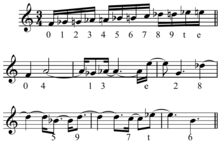
Sectionalisation of the measure/chromatic scale, followed by pitch/time-indicate serial
The term "interval" can also be generalized to other music elements besides pitch. David Lewin's Generalized Musical Intervals and Transformations uses interval as a generic measure of distance between fourth dimension points, timbres, or more abstract musical phenomena.[27] [28]
For example, an interval between two bell-like sounds, which have no pitch salience, is still perceptible. When 2 tones accept similar acoustic spectra (sets of partials), the interval is just the distance of the shift of a tone spectrum along the frequency centrality, then linking to pitches as reference points is non necessary. The same principle naturally applies to pitched tones (with like harmonic spectra), which means that intervals can exist perceived "directly" without pitch recognition. This explains in particular the predominance of interval hearing over absolute pitch hearing.[29] [thirty]
See as well [edit]
- Circle of fifths
- Ear preparation
- List of meantone intervals
- List of pitch intervals
- Music and mathematics
- Pseudo-octave
- Regular temperament
Notes [edit]
- ^ a b c The term tritone is sometimes used more strictly as a synonym of augmented fourth (A4).
- ^ a b The perfect and the augmented unison are also known as perfect and augmented prime.
- ^ The pocket-sized 2d (m2) is sometimes chosen diatonic semitone, while the augmented unison (A1) is sometimes called chromatic semitone.
- ^ a b c d e f one thousand The expression diatonic calibration is herein strictly divers as a seven-tone scale, which is either a sequence of successive natural notes (such as the C-major calibration, C–D–E–F–G–A–B, or the A-minor scale, A–B–C–D–E–F–G) or any transposition thereof. In other words, a calibration that can be written using vii consecutive notes without accidentals on a staff with a conventional central signature, or with no signature. This includes, for example, the major and the natural minor scales, merely does not include another seven-tone scales, such as the melodic pocket-sized and the harmonic minor scales (see also Diatonic and chromatic).
- ^ a b General dominion 1 achieves consistency in the interpretation of symbols such equally CM7, Cm6, and C+7. Some musicians legitimately adopt to think that, in CMvii, M refers to the seventh, rather than to the 3rd. This alternative approach is legitimate, equally both the 3rd and seventh are major, yet it is inconsistent, every bit a like interpretation is impossible for Cmsix and C+7 (in Cmhalf dozen, m cannot possibly refer to the sixth, which is major past definition, and in C+seven, + cannot refer to the seventh, which is minor). Both approaches reveal simply one of the intervals (M3 or M7), and require other rules to complete the task. Whatever is the decoding method, the result is the aforementioned (e.g., CM7 is always conventionally decoded as C–E–Chiliad–B, implying M3, P5, M7). The advantage of dominion 1 is that it has no exceptions, which makes information technology the simplest possible arroyo to decode chord quality.
According to the two approaches, some may format the major seventh chord as CMseven (general rule ane: M refers to M3), and others every bit CM7 (alternative arroyo: M refers to M7). Fortunately, even CM7 becomes uniform with rule 1 if it is considered an abbreviation of CMM7, in which the start K is omitted. The omitted 1000 is the quality of the third, and is deduced according to rule 2 (see above), consistently with the interpretation of the plain symbol C, which past the aforementioned dominion stands for CM.
- ^ All triads are tertian chords (chords divers by sequences of thirds), and a major 3rd would produce in this case a non-tertian chord. Namely, the diminished fifth spans half dozen semitones from root, thus it may be decomposed into a sequence of two minor thirds, each spanning iii semitones (m3 + m3), compatible with the definition of tertian chord. If a major third were used (4 semitones), this would entail a sequence containing a major second (M3 + M2 = four + 2 semitones = six semitones), which would not meet the definition of tertian chord.
References [edit]
- ^ Prout, Ebenezer (1903), "I-Introduction", Harmony, Its Theory and Do (30th edition, revised and largely rewritten ed.), London: Augener; Boston: Boston Music Co., p. 1, ISBN978-0781207836
- ^ a b Lindley, Marking; Campbell, Murray; Greated, Clive (2001). "Interval". In Sadie, Stanley; Tyrrell, John (eds.). The New Grove Dictionary of Music and Musicians (2nd ed.). London: Macmillan. ISBN978-1-56159-239-5.
- ^ Aldwell, E; Schachter, C.; Cadwallader, A. (11 March 2010), "Part one: The Master Materials and Procedures, Unit one", Harmony and Voice Leading (fourth ed.), Schirmer, p. 8, ISBN978-0495189756
- ^ Duffin, Ross W. (2007), "3. Not-keyboard tuning", How Equal Temperament Ruined Harmony (and Why Y'all Should Care) (1st ed.), Westward. West. Norton, ISBN978-0-393-33420-three
- ^ a b c "Prime number (ii). Encounter Unison", Grove Music Online. Oxford University Press. Accessed August 2013. (subscription required))
- ^ a b Definition of Perfect consonance in Godfrey Weber's General music teacher, by Godfrey Weber, 1841.
- ^ Kostka, Stefan; Payne, Dorothy (2008). Tonal Harmony, p. 21. Beginning edition, 1984.
- ^ Prout, Ebenezer (1903). Harmony: Its Theory and Practice, 16th edition. London: Augener & Co. (facsimile reprint, St. Clair Shores, Mich.: Scholarly Printing, 1970), p. 10. ISBN 0-403-00326-i.
- ^ See for example William Lovelock, The Rudiments of Music (New York: St Martin's Printing; London: G. Bell, 1957):[ page needed ], reprinted 1966, 1970, and 1976 by G. Bell, 1971 by St Martins Press, 1981, 1984, and 1986 London: Bell & Hyman. ISBN 9780713507447 (pbk). ISBN 9781873497203
- ^ Drabkin, William (2001). "Fourth". The New Grove Lexicon of Music and Musicians, 2d edition, edited by Stanley Sadie and John Tyrrell. London: Macmillan.
- ^ Helmholtz, H. L. F. (1877) On the Sensations of Tone as a Theoretical Footing for the Theory of Music. 3rd English language edition. Ellis, Alexander J. (trans.) (1895). Longmans, Green, And Co. (p. 172) "The roughness from sounding ii tones together depends... the number of beats produced in a second."
- ^ Helmholtz, H. 50. F. (1877) On the Sensations of Tone as a Theoretical Ground for the Theory of Music. Third English language edition. Ellis, Alexander J. (trans.) (1895). Longmans, Green, And Co. (p. 178) "The cause of this phenomenon must be looked for in the beats produced past the loftier upper partials of such compound tones".
- ^ Helmholtz, H. L. F. (1877) On the Sensations of Tone as a Theoretical Footing for the Theory of Music. Third English edition. Ellis, Alexander J. (trans.) (1895). Longmans, Light-green, And Co. (p. 182).
- ^ Helmholtz, Hermann Fifty. F. On the Sensations of Tone as a Theoretical Footing for the Theory of Music, second English edition, translated by Ellis, Alexander J. (1885) reprinted by Dover Publications with new introduction (1954) ISBN 0-486-60753-4, p. 182d "Just as the coincidences of the two first upper partial tones led the states to the natural consonances of the Octave and Fifth, the coincidences of higher upper partials would lead u.s.a. to a farther series of natural consonances."
- ^ Helmholtz, H. L. F. (1877) On the Sensations of Tone every bit a Theoretical Basis for the Theory of Music. Third English edition. Ellis, Alexander J. (trans.) (1895). Longmans, Green, And Co. (p. 183) "Here I have stopped, because the 7th fractional tone is entirely eliminated, or at least much weakened,".
- ^ a b c Cope, David (1997). Techniques of the Gimmicky Composer, pp. 40–41. New York, New York: Schirmer Books. ISBN 0-02-864737-viii.
- ^ a b Wyatt, Keith (1998). Harmony & Theory... Hal Leonard Corporation. p. 77. ISBN0-7935-7991-0.
- ^ a b Bonds, Marker Evan (2006). A History of Music in Western Culture, p.123. 2d ed. ISBN 0-thirteen-193104-0.
- ^ Aikin, Jim (2004). A Player's Guide to Chords and Harmony: Music Theory for Existent-World Musicians, p. 24. ISBN 0-87930-798-6.
- ^ Károlyi, Ottó (1965), Introducing Music, p. 63. Hammondsworth (England), and New York: Penguin Books. ISBN 0-14-020659-0.
- ^ Hindemith, Paul (1934). The Craft of Musical Composition. New York: Associated Music Publishers. Cited in Cope (1997), p. 40–41.
- ^ Perle, George (1990). The Listening Composer, p. 21. California: University of California Press. ISBN 0-520-06991-9.
- ^ Gioseffo Zarlino, Le Istitutione harmoniche ... nelle quali, oltre le materie appartenenti alla musica, si trovano dichiarati molti luoghi di Poeti, d'Historici e di Filosofi, si come nel leggerle si potrà chiaramente vedere (Venice, 1558): 162.
- ^ J. F. Niermeyer, Mediae latinitatis lexicon minus: Lexique latin médiéval–français/anglais: A Medieval Latin–French/English language Dictionary, abbreviationes et alphabetize fontium composuit C. van de Kieft, adiuvante G. Southward. M. M. Lake-Schoonebeek (Leiden: E. J. Brill, 1976): 955. ISBN 90-04-04794-viii.
- ^ Robert De Handlo: The Rules, and Johannes Hanboys, The Summa: A New Critical Text and Translation, edited and translated by Peter M. Lefferts. Greek & Latin Music Theory 7 (Lincoln: University of Nebraska Press, 1991): 193fn17. ISBN 0803279345.
- ^ Roeder, John (2001). "Interval Class". In Sadie, Stanley; Tyrrell, John (eds.). The New Grove Dictionary of Music and Musicians (2nd ed.). London: Macmillan. ISBN978-1-56159-239-5.
- ^ Lewin, David (1987). Generalized Musical Intervals and Transformations, for example sections 3.3.one and 5.four.2. New Haven: Yale University Printing. Reprinted Oxford University Press, 2007. ISBN 978-0-19-531713-8
- ^ Ockelford, Adam (2005). Repetition in Music: Theoretical and Metatheoretical Perspectives, p. 7. ISBN 0-7546-3573-2. "Lewin posits the notion of musical 'spaces' made upwardly of elements betwixt which we can intuit 'intervals'....Lewin gives a number of examples of musical spaces, including the diatonic gamut of pitches arranged in scalar order; the 12 pitch classes under equal temperament; a succession of fourth dimension-points pulsing at regular temporal distances one time unit apart; and a family of durations, each measuring a temporal span in time units....transformations of timbre are proposed that derive from changes in the spectrum of partials..."
- ^ Tanguiane (Tangian), Andranick (1993). Bogus Perception and Music Recognition. Lecture Notes in Artificial Intelligence. Vol. 746. Berlin-Heidelberg: Springer. ISBN978-three-540-57394-4.
- ^ Tanguiane (Tangian), Andranick (1994). "A principle of correlativity of perception and its awarding to music recognition". Music Perception. xi (4): 465–502. doi:10.2307/40285634. JSTOR 40285634.
External links [edit]
- Gardner, Carl E. (1912): Essentials of Music Theory, p. 38
- "Interval", Encyclopædia Britannica
- Lissajous Curves: Interactive simulation of graphical representations of musical intervals, beats, interference, vibrating strings
- Elements of Harmony: Vertical Intervals
- Just intervals, from the unison to the octave, played on a drone annotation on YouTube

Smallest Interval In Western Music,
Source: https://en.wikipedia.org/wiki/Interval_(music)
Posted by: newellbougereb.blogspot.com
0 Response to "Smallest Interval In Western Music"
Post a Comment